












How Does Agentforce Handle 11 Million AI Calls?
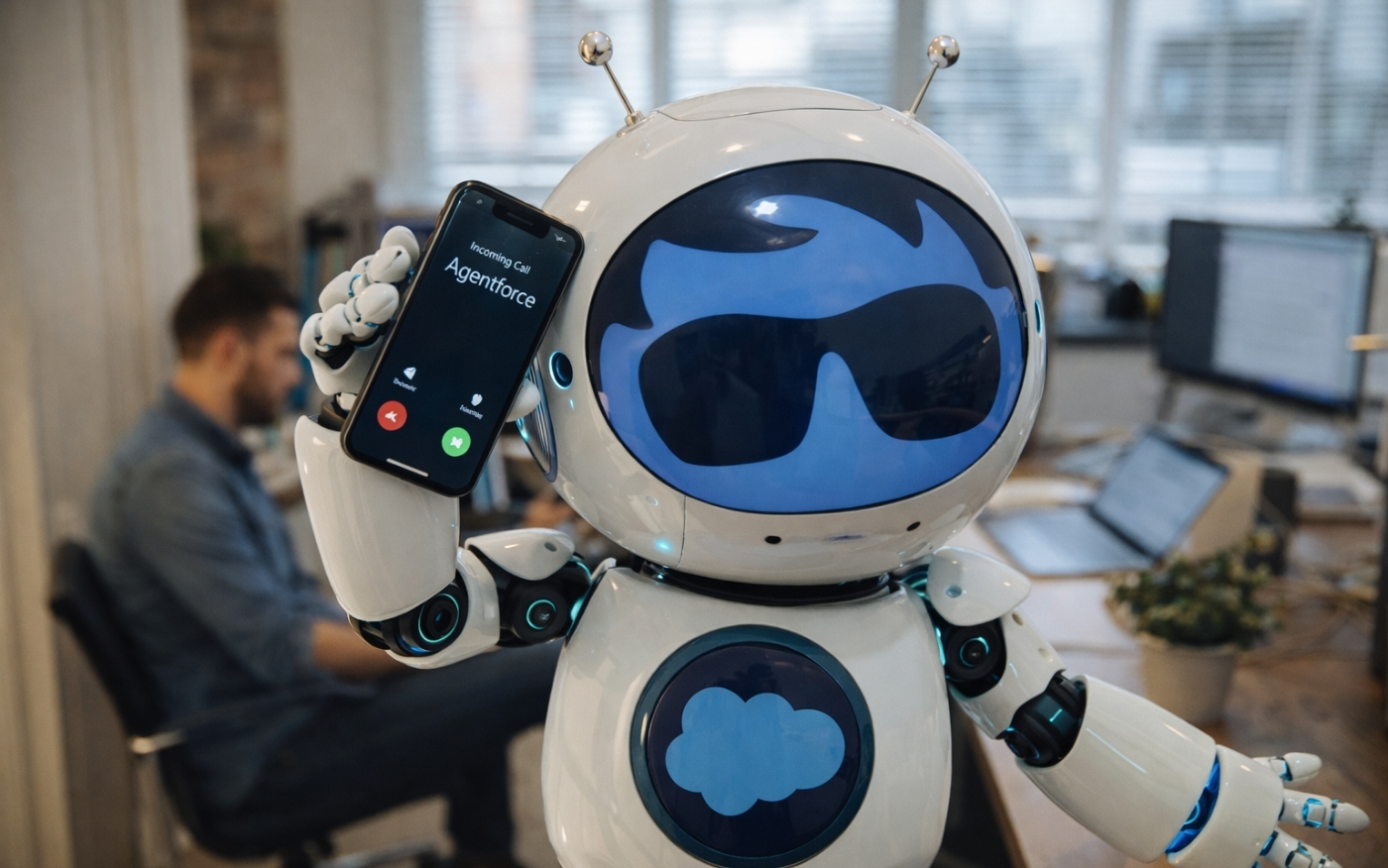
Deploying AI agents at enterprise scale is not difficult. The real challenge is running these agents in production environments in a way that is secure, observable, and governed by clearly defined boundaries.
Salesforce’s Agentforce platform currently manages more than 11 million AI agent calls per day. This scale is not just an operational success. It is the result of an engineering architecture where authentication, authorization, data isolation, and multi-tenant security principles operate simultaneously.
Every Agent Call Passes Through a Control Layer
No AI agent call running on Agentforce reaches application logic directly. Every request first passes through a centralized access and control layer.
This layer applies three fundamental checks:
Authentication
Authorization verification
Validation of data access boundaries
For every request, the system automatically answers the following questions:
Which organization does this user or agent belong to?
What data is it authorized to access?
Could this operation affect another tenant’s data?
With this architecture, calls operate strictly within permitted data boundaries. Unauthorized access is technically impossible.
How Thousands of Companies Stay Secure on the Same Infrastructure
Salesforce infrastructure is not dedicated to a single company. Thousands of organizations operate on the same platform. Each company uses its own data, runs its own processes, and deploys its own AI agents while sharing the same core infrastructure. In this model, the most critical factor is clear data boundaries.
The Agentforce architecture establishes strict isolation for every organization. An AI agent belonging to one company can only access that company’s data. Accessing another organization’s customer records, order data, or transaction history is technically impossible. These boundaries are not limited to data access alone. Traffic management and failure isolation follow the same principle.
Isolation of operational traffic
A spike in activity within one organization does not affect others.
Isolation of system failures
A technical issue occurring in one environment remains contained and does not propagate to other tenants.
This approach forms the foundation of security in large-scale platforms. When millions of AI calls are processed simultaneously, each request must remain within its own operational boundary.
Agentforce guarantees data isolation and operational security by design, even within a multi-tenant architecture. As scale grows, risk does not increase — control remains intact.
The Security Layer Does Not Slow Down Performance
In high-volume systems, security often introduces performance overhead. In Agentforce, however, security and scale are designed together.
Identity and authorization checks operate in a distributed manner. Access validation runs on a centralized yet horizontally scalable architecture. Call traffic is dynamically balanced across the system.
Low latency
Response times remain consistently low.
Horizontal scalability
Call processing capacity can increase by adding more nodes.
No security bottlenecks
Security checks do not become performance constraints.
Managing 11 million calls per day sustainably becomes possible because of this architectural approach.
Other Trend Reports

Teams and Agents Build Together with Slack Code
Slack Code takes software development out of private tabs and turns it into a collaborative process in the open with the team. 70% of code channels are opened and closed within a single day.

Dreamforce 2026 Preparation Guide
Everything You Need to Know Before Dreamforce 2026, taking place in San Francisco from September 15–17. Sessions, demo areas, registration details, and more.

When AI Agents Start Working Together, Who Ensures Trust?
How can companies trust AI agents that negotiate, decide, and transact? Identity, reputation, accountability, and human oversight are key.